Korea Market Entry / Insights
Korean startups for accelerators · 11 min read
How to Find Great Korean Startups: Ecosystem Strengths in Digital Health, AI Agents and Manufacturing
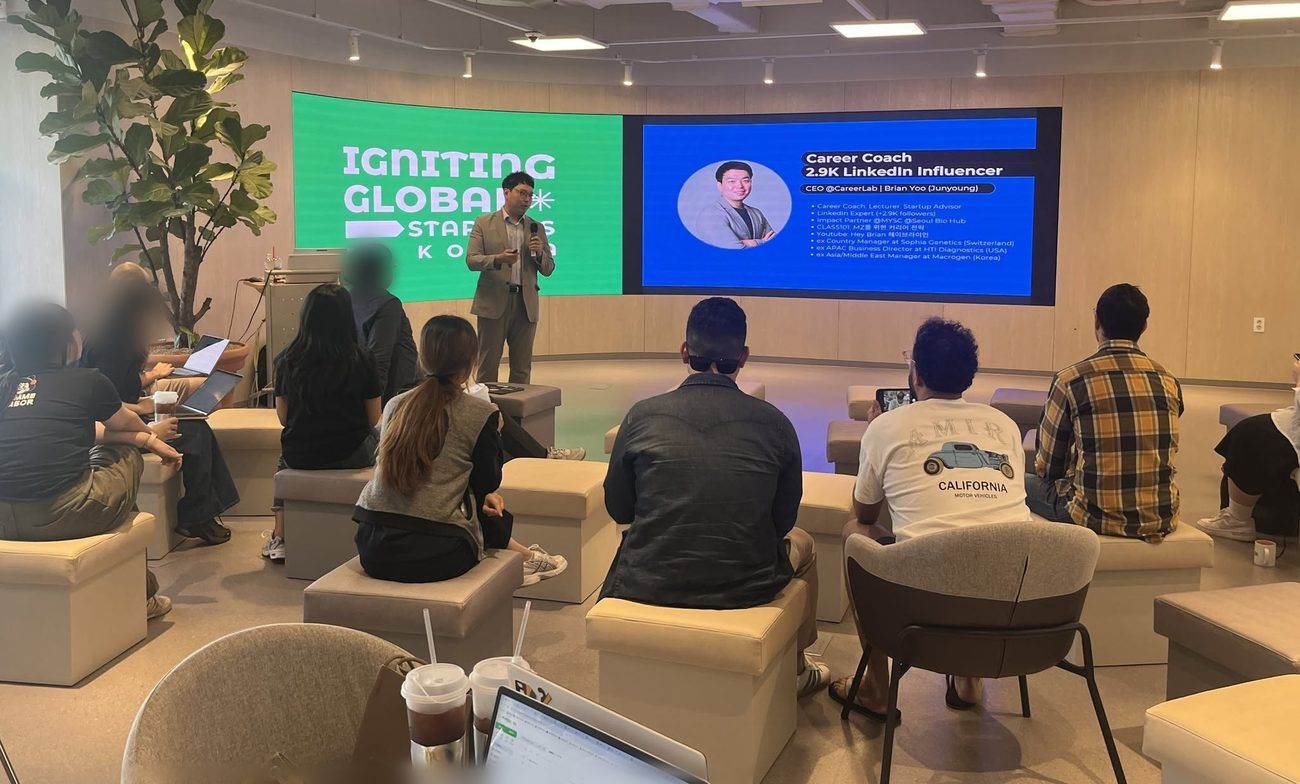
Korea is one of the few countries where a foreign accelerator can find AI agents, digital health, bio and hardware startups in one ecosystem, with government funding behind many of them and large corporations ready to run pilots. Korean founders are also active on the global stage, with 853 Korean companies reported at CES 2026. This guide is for foreign accelerators, funds and corporate teams that want to find good Korean startups. It explains the structure, the strong sectors, how Samsung and Hyundai open innovation fits, and an eight-step sourcing process.
01
Why accelerators keep looking at Korea
If you run an accelerator, a venture fund or a corporate innovation team outside Korea, you have probably noticed Korean startups at the big global shows. At CES 2026, the show director told The Korea Times that 853 Korean companies were taking part, the third-largest national presence after the United States and China, and Korean startups had the largest share of startups from any single country. The CEO of the Consumer Technology Association told the Korea JoongAng Daily that almost 400 of the Korean exhibitors were startups.
These companies come to global shows because their home market is small compared with their ambitions. Many are built to sell abroad from the first year. For a foreign accelerator, that means a pipeline of teams that already want an international partner, a pilot customer or a first foreign investor.
This guide explains how the system behind them works, which sectors I think are strongest, how large Korean companies connect with startups, and how to build a sourcing process that does not depend on luck.
02
A government-led ecosystem, and why that helps you
Korea does not build startups through private angels alone. Public institutions design much of the structure: government R&D grants, loan guarantees, funds of funds, regional creative economy centers and programs that match private investors with public money. I explained each piece in my guide to the Korean startup ecosystem, so I will keep this short.
The program most foreign investors hear about first is TIPS. It pairs a private operator, often an accelerator or a venture firm, with government R&D money for a startup. For you, the practical meaning is that a startup with a TIPS operator has already passed a private investor's review and has public funding for development. That makes TIPS alumni a useful first filter.
The structure also changes how you should read a Korean startup. A startup may have strong technology and a long grant history, but little commercial revenue. Ask for both. Public money funds development well. It does not prove that customers will pay.
- Ask which public programs the company has joined and in what year.
- Ask what share of revenue comes from customers and what share from grants or government contracts.
- Ask who the private investor or TIPS operator is, and whether you can speak with them.
03
Sector 1: digital health and AI medical devices
Digital health is where Korean startups have shown the clearest path from lab to global business. The best-known example is Lunit, an AI company founded in 2013 that builds software for cancer screening and cancer treatment decisions. Its main products are Lunit INSIGHT, which reads medical images, and Lunit SCOPE, an AI biomarker platform. Lunit listed on KOSDAQ in July 2022 after earning a technology rating that qualifies companies for a special listing track, and in 2024 it completed the 193 million dollar acquisition of Volpara Health, a company in breast imaging software, to expand in the United States.
What makes this useful for you is the sequence. A Korean team built a clinical product, got evidence in hospitals, listed on its home exchange to fund growth, then bought a foreign company to enter a bigger market. Many Korean digital health startups are following a similar plan on a smaller scale, and they are looking for foreign clinical partners, distributors and investors.
If your accelerator has a health track, look at Korean radiology AI, remote monitoring, digital therapeutics and hospital workflow software.
04
Sector 2: pharma, biotech and medical technology
Korea has a deep base of bio and medical companies, from large pharmaceutical firms to small drug discovery and diagnostics startups. I started my own career in a Korean bio company before moving to Swiss and US bio companies in the same field, so I know how these companies talk to foreign partners.
Hospitals are also an unusual strength. Large Korean hospitals run clinical studies and test new products, and Korean regulators publish clear paths for medical device approval. If you want a pilot site in Asia, ask Korean startups where their clinical evidence came from.
Questions to ask in this sector: which clinical sites have used the product, what approvals the company holds and in which countries, and who owns the data from the studies.
05
Sector 3: AI agents and enterprise software
Korean startups building AI agents and business software are growing fast, helped by large local companies that buy early and by strong engineering talent. Many of them sell first to Korean enterprises, then expand to Japan, Southeast Asia and the United States.
For an accelerator, this sector is easier to evaluate than hardware. You can test the product, read the documentation and speak to Korean customers. The typical weakness is English go-to-market. Many teams have excellent engineers and no one who can write a foreign sales email or run a call with a US buyer.
That gap is your opportunity. A foreign accelerator that provides English sales coaching and introductions to customers abroad offers something Korean founders value highly.
06
Sector 4: manufacturing and hardware, with partner structures
Korea is also a manufacturing country, and this is a strength that most other startup ecosystems cannot match. Electronics, batteries, materials, automotive parts, shipbuilding and precision equipment all have supply chains within a few hours of Seoul.
A hardware startup in Korea can often move from prototype to small-batch production by working with established manufacturers, instead of building its own factory. A foreign company that wants to produce in Asia can do the same, partnering with a Korean startup that already has the technology and a factory relationship.
For a foreign investor, the structure to look for is a startup that owns the design or the core technology and a partner manufacturer that produces under contract. Ask who owns the tooling, who handles quality control and what happens if the manufacturer changes terms.
07
Corporate open innovation: Samsung, Hyundai and others
Korean conglomerates are more open to startups than their reputation suggests, and a foreign accelerator can use that.
Samsung Electronics launched C-Lab Outside in 2018 as an external version of its internal C-Lab. At launch, selected startups received up to 100 million won in support, mentoring, and chances to exhibit at overseas shows such as CES. The company said it planned to support 500 startups over five years, including 300 external ones. In the first round, 15 external startups were selected from 331 applicants.
Hyundai Motor Group runs ZER01NE, an open innovation platform. Its accelerator has run since 2018 and, according to Hyundai, has included more than 180 startup cohorts and 130 collaborative projects. The group also operates Hyundai CRADLE innovation hubs in Silicon Valley, Tel Aviv, Berlin, Beijing and Singapore, which are useful if your startups want a path to Hyundai business units.
What this means for you: if your portfolio company has a product that fits a conglomerate's business, a Korean pilot with one of these groups can give you a reference customer in your first year.
- Check the current application windows on each program site. Programs change from year to year.
- Prepare a one-page proof of fit, which business unit would use your product, and what the pilot looks like.
- Ask Korean startups in your pipeline whether they have worked with a conglomerate program. Those teams already know the process.
08
Why global shows matter in Korea
Korean startups and public agencies treat CES as a first-order event. The Korea Pavilion and national support programs fund booth space, translators and meeting support. For a foreign accelerator, this makes CES a concentrated sourcing week. You can meet hundreds of Korean companies in a few days, and the best teams arrive with English materials.
I wrote a separate guide on how to prepare for CES 2027 and meet Korean startups there. The short version: book meetings before you fly, use LinkedIn to contact founders, and ask for a follow-up call within a week.
09
A sourcing process you can run in eight steps
- Define your thesis in one line, for example Korean AI medical software with hospital pilots.
- List the public programs that match your thesis: TIPS operators, regional creative economy centers and university labs.
- Review the portfolios of Korean accelerators and venture firms active in your sector.
- Read the exhibitor lists of CES and other major shows and filter by your thesis.
- Contact founders on LinkedIn with a short message and one specific reason, such as a pilot site or a distribution channel.
- Hold a first video call, ask for English materials and evidence of customers.
- Request a reference from a Korean investor, a hospital, a customer or a corporate partner.
- Visit Seoul for a week of meetings, with a local partner who can open doors and translate nuance.
The slowest step is trust building, because Korean founders are cautious about foreign investors who ask for data before showing value. Offer something first: an introduction, a pilot site, feedback on the pitch.
10
Common mistakes foreign accelerators make
- Treating a grant as a revenue signal.
- Expecting a Korean founder to reply to a cold email in one day, without a warm introduction.
- Asking for exclusivity too early.
- Ignoring the Korean language. Even if the founder speaks English, customer proof, regulatory documents and press coverage are often in Korean.
- Skipping the question of who in the company makes the decision.
11
How I can help
I am a mentor at Founder Institute Korea and work with Korean startups and foreign partners on outbound strategy, LinkedIn positioning and buyer and investor introductions. If you are building a Korean pipeline, send me your thesis and I can suggest sectors, programs and contacts that match.
For a deeper explanation of how foreign investors source Korean startups, see my earlier guide below.
A quick self check
- Is my sourcing thesis written in one sentence with a sector and a stage?
- Do I know which public programs and operators sit behind each target startup?
- Did I ask for customer revenue separately from grants?
- Have I checked current open call dates for corporate programs?
- Do I have a warm introduction, not just a cold email, for my top ten targets?
Sources
- The Korea Times, Korea's AI, health care firms have strong showing at CES 2026 (January 8, 2026).
- Korea JoongAng Daily, CES organizer cites Korea's startup culture ahead of 2027 show.
- KoreaTechDesk, Lunit IPO to debut on KOSDAQ in July (June 2022).
- AuntMinnie, Lunit completes 193 million dollar acquisition of Volpara.
- Korea JoongAng Daily, Samsung opens C-Lab to outside innovators (2018).
- Hyundai Motor Group, ZER01NE.
Where to go next
Related reading: how foreign investors and accelerators source Korean startups, Korea's startup ecosystem explained, how to meet Korean startups at CES 2027 and the Korean Startups series. See also how to run a Korea program or Demo Day as a foreign accelerator.
What we offer
- B2B trust building and partner development strategy consulting for foreign startups and companies entering the Korean market
- LinkedIn company branding, content strategy, and overseas buyer and partner development support for Korean startups expanding abroad
- B2B marketing lectures, seminars, and hands on consulting for corporate and government backed programs
Contact: yooharmonizer@gmail.com